
Quartet Guitar: Legacy and Influence
25 Feb 2026
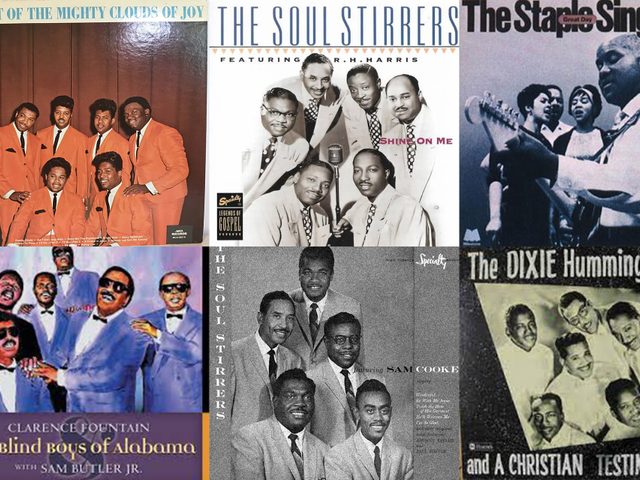
The lineage of black gospel quartet music has always centered on voices, but the guitar has often decided how the music moves. From the traveling quartets of the 1940s and ’50s to today’s gospel and worship stages, quartet guitar built a distinct vocabulary that still shows up everywhere.
This article follows that progression, exploring the history, from foundational players to broader cultural influence, and concludes with reflections from PRS artists who carry this vocabulary forward.
The Foundation:
Rhythm first groups like The Dixie Hummingbirds helped establish the core sound of traditional quartet music. The arrangements were vocal-driven, but the guitar supplied the motion underneath: short percussive chord hits, blues-based turnarounds, quick fills between lines, and steady time that locked with the drummer and the bass. The quartet guitar wasn’t built for long solos. It was built for placement. The guitarist supported the lead, reinforced the lyrics, and responded to dynamic shifts in real time. Time feel, harmonic awareness, and restraint mattered more than flash. That’s the heart of the style: blues language shaped by the church; direct, intentional, and deeply rhythmic.
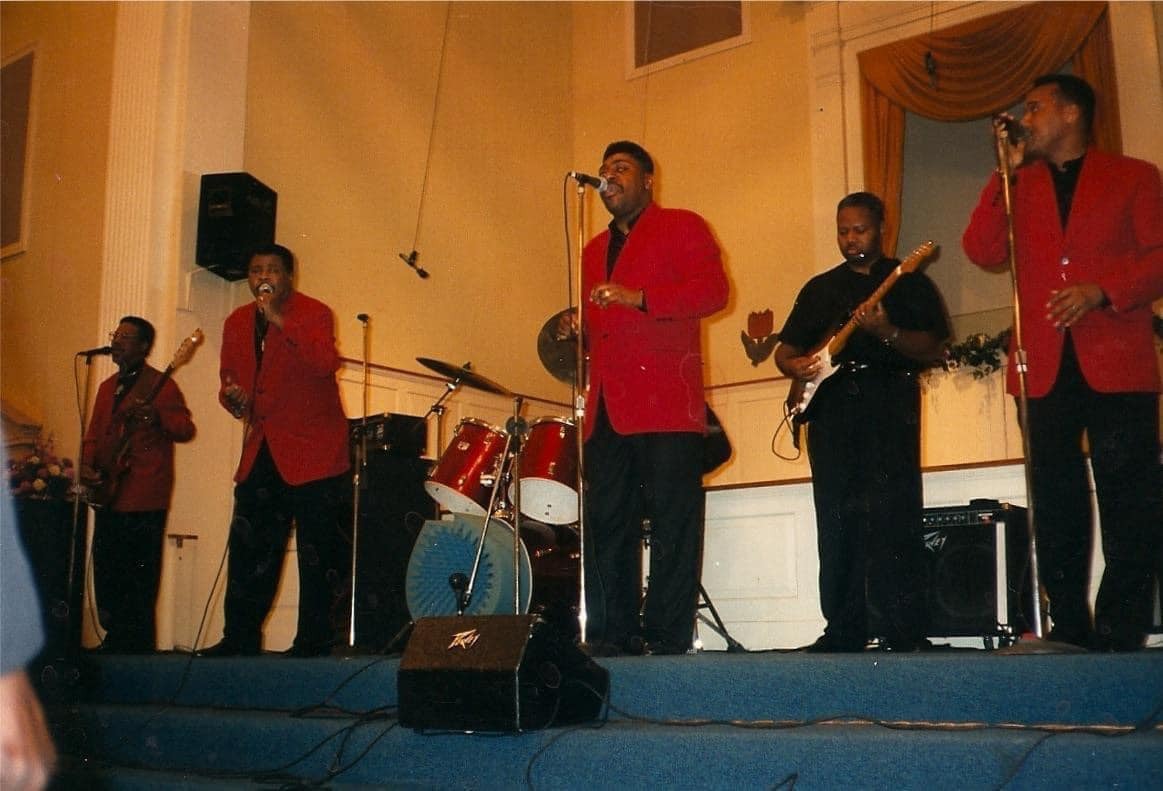
Mighty Clouds Of Joy: Courtesy of Kevin Wilson
Expansion and Refinement:
As quartet evolved through the ’70s, ’80s, and ’90s, the guitar language broadened harmonically. One key bridge in that shift was Spanky Alford. Spanky didn’t just influence gospel guitar; he helped redefine what rhythm guitar could be across genres. Rooted in quartet vocabulary, he carried that language into jazz settings, contemporary R&B, and hip-hop with Black church music discipline: tight chord clusters, conversational fills, and a tone that spoke like a voice: clean, warm, and controlled. Most notably, his work with D’Angelo helped shape the harmonic and rhythmic identity of neo-soul. The muted movement, pocket-driven phrasing, and slick voicings that became synonymous with that era carried clear quartet DNA.
On the Road:
Before online tutorials and social clips, quartet guitar was refined on the road. Touring groups performed several nights a week, sometimes with minimal rehearsal. Songs could stretch without warning. Tempos could shift on the fly. The guitarist had to anticipate transitions, respond to the lead singer, and keep the groove steady no matter what happened. That environment built something you can’t fake: timing, vocabulary, and instinct. It reinforced the main rule: the guitar serves the song and the moment.
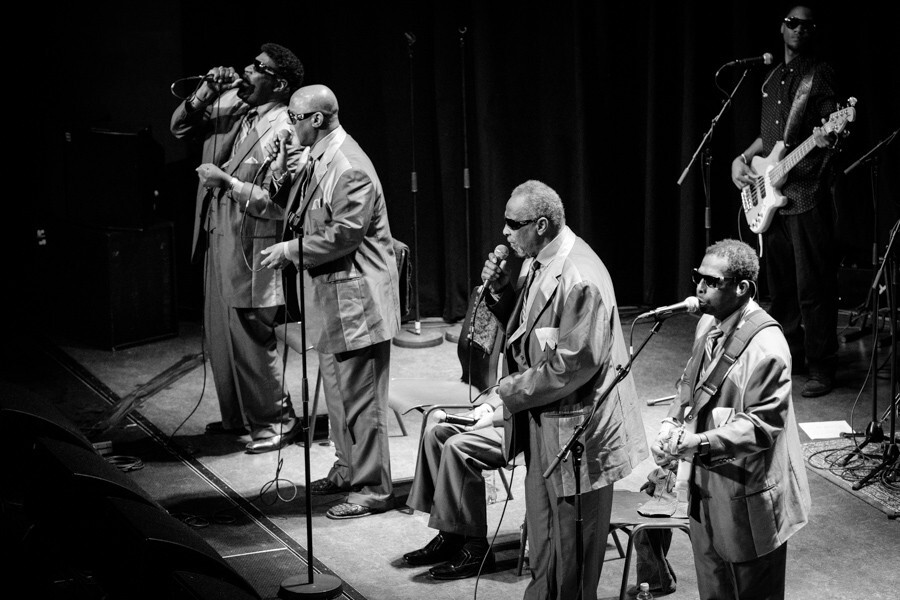
Blind Boys of Alabama | Photo Cred: Tore Saetre
The Lasting Influence Today:
Quartet phrasing shows up across gospel, R&B, neo-soul, and beyond. Inverted chord shapes, smooth voice leading, and short call-and-response fills between vocal lines are quartet traits that have become part of the broader guitar language. Even players outside gospel draw on techniques developed in quartet settings: right-hand muting, rhythmic chord-driving, subtle dynamics, and harmonically rich yet supportive voicings. Black gospel quartet guitar may not always get credit in modern guitar history conversations, but it should, because the influence is obvious. It reshaped rhythm playing. It made harmonic depth feel accessible. And it proved that feel, timing, and tone carry more weight than volume or speed. The vocabulary will keep evolving, but the foundation stays the same: quartet tradition is movement, message, and pocket.
PRS: What defines Black gospel quartet guitar?
Kevin: Discipline, Phrasing, voicing, and being able to spend on the dime. Before there were keyboards, drums & bass, there was guitar only. Guitar players carry the entire structure of the music.
PRS: How did the road shape your playing?
Kevin: Prior to the advent of social media, the University of Hard Knocks, also known as The Chitterling Circuit, served as a pivotal educational institution for aspiring guitarists. I frequently found myself in the hotel room or dressing room, engaging in hands-on instruction with renowned guitarists such as Mr. Howard Carroll, Spanky, Sterling Hollowman (the father of the whammy bar), and Sugar Hightower (the house guitarist at the Apollo Theater at the tender age of 15, who also introduced the Wah pedal and distortion to quartet music).
These legendary guitarists imparted invaluable knowledge, shaping my aspirations to become a professional guitarist. However, their teaching methods were not always conducive to my emotional well-being. They prioritized achieving perfection, disregarding my feelings. Failure was met with swift dismissal, and I was once informed that playing a particular song incorrectly would result in my expulsion from the bus in the middle of the night on I-95 at 2:00 AM. Despite the challenges, the road provided an exceptional education. It propelled me from a small-town church to the 1996 Olympics, from Amityville, New York, to being inducted into the Hall of Fame with the Mighty Clouds of Joy. I transitioned from playing at a 25-seat venue to performing at the Houston Astrodome. One year, I worked an astonishing 290 days. Throughout my career, I had the privilege of performing with legendary artists such as Ray Charles, Tower of Power, The Rolling Stones, and even Paul Simon for an impressive 30 days at Madison Square Garden in New York City. As a member of the Clouds, we made history as the first gospel artist to perform on Soul Train, while DJs at Studio 54 in New York were playing our song “Mighty High.” The road not only honed my guitar skills but also profoundly impacted my life.
PRS: What’s something younger players misunderstand about the style?
Erick: I think a lot of players get caught up in the flashiness of the style and miss out on its greatest function, which is rhythm/pocket. To play quartet correctly, the player must have the ability to play a part that sits in the song without deviating much from the pattern. It’s not a simple task. That rhythm support is literally the backbone of the whole style!
PRS: How does quartet phrasing show up in modern sessions?
Erick: A lot of modern music has quartet inspired guitar in it. Artists such as John Mayer, SZA, Kehlani, Leon Thomas, Ari Lennox, and Bryson Tiller have all infused traditional quartet rhythms and techniques into their music. The most common quartet technique I’ve noticed in modern music is the use of chord pull-offs. Its introduction into popular music probably can be credited to the legendary Curtis Mayfield.